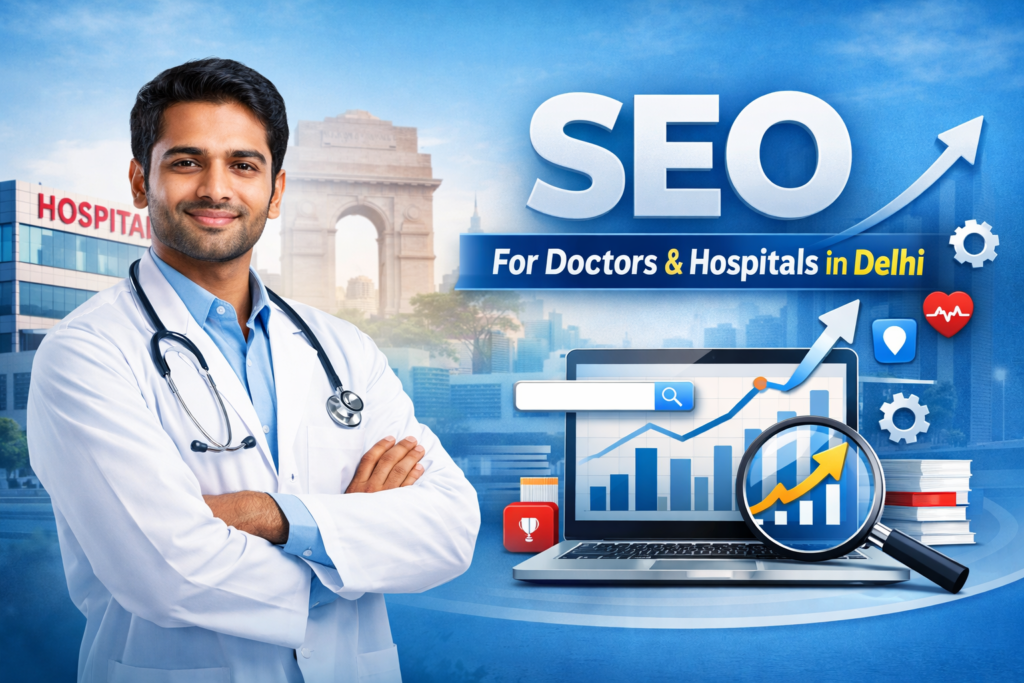
Delhi has one of the busiest healthcare markets in the country, and patients here rarely walk into a clinic without checking Google first. Whether someone is looking for a paediatrician in Rohini, a dermatologist in Karol Bagh, or an IVF specialist near Dwarka, the search almost always starts online. If your practice isn’t visible in those results, you’re not losing patients to bad service, you’re losing them before they even know you exist.
That’s the gap a specialised Healthcare SEO Agency in Delhi is meant to close. Not a generic marketing team that treats a hospital website the same way it would a clothing store, but a partner who understands patient search behaviour, medical advertising rules, and what actually earns trust on a Google results page. This page walks through what real Healthcare SEO Services in Delhi look like, why doctors need an SEO agency for doctors rather than an all-purpose agency, and what results a well-run strategy should realistically deliver.
Why Delhi’s Healthcare Market Needs a Different Kind of SEO?
Ranking a hospital or a doctor’s website isn’t the same problem as ranking an online store. Google treats medical websites as YMYL pages, short for ‘Your Money or Your Life’ — content that can genuinely affect a person’s health or finances gets held to a much higher bar. That means accuracy, credentials, and trustworthy sourcing matter far more here than on a typical business site.
On top of that, Delhi NCR is intensely local and intensely competitive. A patient searching for a ‘knee replacement surgeon near Saket’ isn’t going to scroll through results for all of Delhi; they want someone close by, credible, and available soon. A large share of these searches also happen in Hindi or in Hinglish, so a strategy built only around English keywords misses a real slice of potential patients. Add in advertising restrictions from the National Medical Commission that limit testimonials and comparative claims, and it becomes clear why a general digital marketing agency often struggles here — the rules of the game are simply different.
What a Genuine SEO Agency for Doctors Actually Does?
A lot of clinics have already tried a general-purpose agency and came away unimpressed — usually because the strategy didn’t account for how patients actually search, or worse, drifted into claims that could put a doctor’s registration at risk. Here’s how the two approaches typically compare.
| What to Look For | Generic Agency | Dedicated Healthcare SEO Partner |
| Understanding of patient search intent | Treated like any product search | Built around symptoms, procedures & local intent |
| Medical advertising compliance | Rarely considered | Checked against NMC guidelines |
| Google Business Profile for clinics | Basic listing only | Fully optimised with categories, posts & reviews |
| Content writing | General copywriters | Writers familiar with medical terminology |
| Schema markup | Often skipped | Physician / Hospital schema implemented |
| Hindi & English search coverage | English only | Both, including common transliterated terms |
None of this is about jargon for its own sake — it’s the difference between a website Google is comfortable recommending to someone making a health decision, and one it quietly pushes down the page.
Healthcare SEO Services in Delhi: What’s Actually Included?
1. Local SEO & Google Business Profile
For most clinics, this is where the bulk of new patients come from. When someone searches ‘gynaecologist near me’ or ‘best dentist in Vasant Kunj’, the map results at the top of the page get the clicks. That means a complete, verified Google Business Profile with consistent name, address and phone details, the right medical categories, regular posts about services, and a steady flow of genuine patient reviews — plus separate location pages if you run more than one branch across areas like Noida, Gurugram or Dwarka.
2. On-Page SEO for Medical Websites
Your website needs to speak the same language your patients type into Google — things like ‘IVF cost in Delhi’ or ‘best physiotherapist for back pain’. That means mapping each service to the right keyword, writing clear titles and headings, structuring pages so both patients and Google can follow them easily, and making sure the site loads quickly on a phone, since the majority of health searches in Delhi happen on mobile.
3. Medically-Informed Content
Content is what turns a visitor into a booked appointment, but in healthcare it has to be accurate first and persuasive second. That means procedure explainers, condition guides, and FAQ-style pages written with real medical understanding, checked against NMC advertising norms, and structured clearly enough that Google’s AI-generated answers can pull from it rather than from a competitor’s site.
4. Technical SEO
None of the above matters if the site itself is slow, insecure, or hard for Google to crawl. This covers HTTPS security, fixing duplicate pages across multi-branch hospital sites, structured data for doctors and procedures, and keeping Core Web Vitals — the speed and stability metrics Google actively uses in rankings — in good shape.
5. Reputation Management
A handful of unanswered negative reviews can quietly turn away far more patients than they should. This means encouraging happy patients to leave honest reviews, responding to negative ones professionally and without breaching patient confidentiality, and keeping an eye on how your practice is discussed across platforms like Practo and Lybrate.
How Google’s AI Overviews Are Changing Medical Search?
Increasingly, Google answers medical questions directly at the top of the page using AI-generated summaries pulled from a handful of trusted sites. If your content isn’t structured clearly enough to be one of those sources, you effectively become invisible for that search — even if you rank reasonably well further down. Getting featured here isn’t about tricking the algorithm; it’s about writing content that genuinely demonstrates expertise, cites credentials, and answers the patient’s question clearly near the top of the page. This is quickly becoming one of the biggest differentiators between practices that show up and practices that don’t.
What Results Should You Expect, and When?
Anyone promising first-page rankings in a week isn’t being straight with you. SEO is compounding — early wins are small and local, but they build steadily. A realistic timeline looks roughly like this:
- Months 1–2: Technical fixes, Google Business Profile setup, and foundational content go live. Local map visibility often starts improving within the first few weeks.
- Months 3–4: New content starts ranking for longer, more specific search terms, and enquiry volume from organic search begins to tick up.
- Months 5–6: Core service keywords move toward page one, and content begins showing up in AI-generated answers for relevant queries.
- Month 7 onward: Growth compounds — organic traffic and appointment enquiries keep climbing as the site’s overall authority builds, typically at a much lower ongoing cost than paid ads.
Who This Is For?
A tailored Healthcare SEO Agency in Delhi approach works well for:
- Individual specialists — cardiologists, dermatologists, orthopaedic surgeons, IVF specialists and more
- Private clinics and nursing homes looking to grow their local patient base
- Multi-specialty hospitals competing across several departments at once
- Diagnostic centres and pathology labs targeting preventive-care and test-specific searches
- Dental, eye-care and cosmetic practices in highly competitive local markets
Choosing the Right Healthcare SEO Partner
When you’re comparing an SEO agency for doctors, it’s worth asking a few direct questions: Do they understand NMC advertising restrictions? Do they write content in-house with real medical knowledge, or outsource it generically? Do they report on actual appointment enquiries, or only on vanity metrics like traffic? A partner worth keeping around should be comfortable answering all three clearly, in plain language, without hiding behind jargon.
The clinics and hospitals that grow steadily online tend to share one thing in common: they treat SEO as an ongoing part of running the practice, not a one-time project. That mindset, paired with a partner who genuinely understands healthcare, is what turns search visibility into a full appointment book.
Frequently Asked Questions
How long does healthcare SEO take to show results in Delhi?
Most clinics start seeing early movement in local visibility within four to eight weeks, with meaningful growth in enquiries typically building over three to six months.
Is SEO better than running Google Ads for a clinic?
They serve different purposes. Ads bring quick visibility but stop the moment you stop paying; SEO takes longer to build but keeps working in the background and usually costs far less per patient over time. Most practices benefit from both, weighted differently depending on budget and timeline.
Can SEO content follow NMC advertising guidelines?
Yes — it has to. Compliant medical SEO content avoids comparative claims and testimonials that cross regulatory lines, while still being genuinely informative and easy to find in search.
Do you write content in Hindi as well as English?
Given how many Delhi patients search in Hindi or in transliterated Hindi-English, bilingual content is often part of a complete local strategy, not an optional extra.
Ready to Get Found by More Patients?
Your next patient is searching for exactly what you offer, right now. Whether they end up finding you or a competitor down the street often comes down to whether your practice has invested in the kind of Healthcare SEO Services in Delhi built specifically for medical providers. If you’d like a clear, no-jargon look at where your practice currently stands online and what it would take to move up, that’s a conversation worth having sooner rather than later.

Shalini Verma is a Healthcare SEO specialist with over 10 years of experience helping doctors, clinics, and hospitals grow their online presence through strategic, ethical search optimization. She has worked extensively on medical website optimization, local SEO, and organic traffic growth, focusing on improving search rankings and increasing patient appointments. With deep industry knowledge and a data-driven approach, Shalini helps healthcare practices build long-term visibility and trust in competitive markets.