
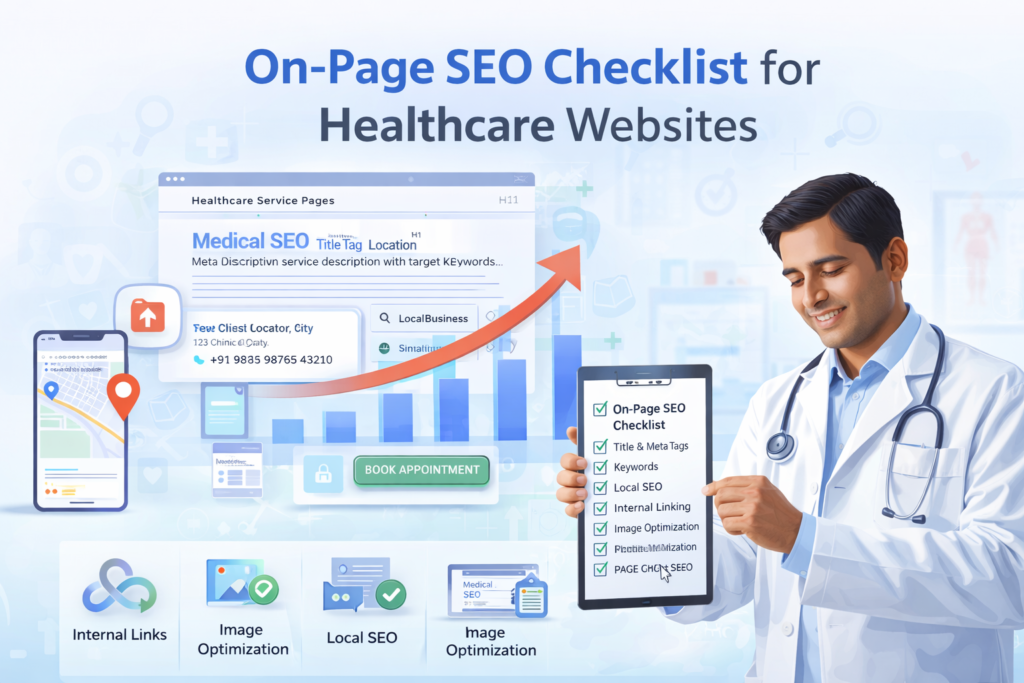
Having a medical website is simply not sufficient in todays highly competitive digital environment. To draw a steady flow of patient inquiries, your website needs to be well, optimized for search engines. A thorough On, Page SEO checklist for healthcare websites that is meticulously executed will result in greater visibility, higher rankings, and more appointment conversions.
Below is a comprehensive checklist that will enable individual doctors, clinics, hospitals, and diagnostic centers to fortify their medical SEO groundwork.
1. Optimize Title Tags and Meta Descriptions
Make sure your title tag has your main keyword, your location (if relevant), and the service. For example:
“Best Orthopedic Doctor in Delhi | Knee Pain Specialist”
Your meta description should be a concise explanation of your service that also entices the reader to click. Do not exceed 160 characters and make sure to include your target keyword naturally.
Thus, it enhances the click, through rate (CTR) and also increases search visibility.
2. Use Proper Heading Structure (H1, H2, H3)
Each healthcare page should have:
One H1 tag (representing the main page topic)
Hierarchically, arranged H2 and H3 tags for subtopics
Words like Medical SEO, Local SEO for doctors or healthcare website optimization inserted naturally
Search engines rely on headings to get the gist of your content structure.
3. Optimize Service Page Content
Your service page should:
Contain at least 800, 1200 words
Include treatment, related keywords
Focus on location, specific keywords (if it is a local clinic)
Clearly describe symptoms, procedures and advantages
Well, written content attracts more organic visitors and it also serves as a trust, building tool for patients.
4. Improve URL Structure
Your URLs need to be:
short and clean containing keyword seasily readable Example:
yourwebsite.com/orthopedic, seo, services
Instead of:
yourwebsite.com/page?id=123
Clean URLs definitely help to improve search engine rankings.
5. Optimize Images and Alt Text
Healthcare websites usually show images of treatments, pictures of clinics, and photos of doctors. So, ensure that:
Images are compressed without losing quality for quick loading times Alt text incorporates relevant keywords File names are descriptive (dental, implant, treatment.jpg, for example)This way, you get the best of both worlds: technical SEO and catering to the needs of your handicapped users.
6. Internal Linking Strategy
Internal links allow search engines to easily go over your site.
Blog posts to the relevant service pages Service pages to the contact page Related treatments to each other A strong internal linking structure not only elevates your website’s authority but also significantly enhances user experience.
7. Mobile Optimization and Page Speed
Most patients use their mobile devices to do a search. Therefore, your healthcare website should:
Load in less than 3 seconds Be completely mobile responsive Have an easy, to, navigate interface and buttons that are easy to click Among the ranking factors, Google gives more weight to the mobile, friendliness of a website, especially in the case of healthcare, related searches.
8. Add Schema Markup
Schema is a type of code that helps to make your website more detailed in search results. Healthcare websites can rely on:
Medical Organization schema, local Business schema, FAQ schema, All that leads to a better online presence and gaining trust.
9. Optimize for Local SEO
For clinics and doctors, Local SEO plays a vital role.
Make sure:
NAP (Name, Address, Phone) stays consistent through out Google Business Profile is fully optimized and ready to be discovered by customers Location, based keywords This elevates the chances of your business showing up on Google Maps results.
10. Include Strong Calls, to, Action (CTA)
Every page should guide patients clearly:
- “Book an Appointment”
- “Call Now”
- “Schedule Consultation”
Clear CTAs improve conversion rates from organic visitors.
Final Thoughts
Going through this On, Page SEO checklist for healthcare websites will help you ensure that your medical practice is well, optimized for higher search rankings, a better user experience, and a steady increase in patients. Thoughtful healthcare website optimization is a great way to establish lasting authority and maintain a steady flow of organic visibility.
FAQs:
On-Page SEO for healthcare websites refers to optimizing elements within your website, such as content, headings, keywords, meta tags, internal links, and technical structure, to improve search engine rankings and attract more patient inquiries.
On-Page SEO helps doctors and clinics rank higher on Google for treatment-based and location-specific searches. This increases organic visibility, builds trust, and generates more appointment bookings without relying solely on paid ads.
Healthcare service pages should include relevant medical keywords, clear treatment explanations, structured headings (H1, H2, H3), internal links, optimized images, and strong calls-to-action. High-quality, informative content improves both rankings and patient trust.
Local SEO is essential for healthcare providers. Including location-based keywords, consistent NAP details, and optimizing Google Business Profile helps clinics appear in Google Maps and local search results.
Results from On-Page SEO typically start appearing within 4–12 weeks, depending on competition, website authority, and optimization quality. Consistent updates and technical improvements accelerate long-term organic growth.

Shalini Verma is a Healthcare SEO specialist with over 10 years of experience helping doctors, clinics, and hospitals grow their online presence through strategic, ethical search optimization. She has worked extensively on medical website optimization, local SEO, and organic traffic growth, focusing on improving search rankings and increasing patient appointments. With deep industry knowledge and a data-driven approach, Shalini helps healthcare practices build long-term visibility and trust in competitive markets.